
Advancements in Secure Data Management for AI-Driven Information Systems
Dive into the forefront of Computer/IT innovation with Current Trends in Information Technology (CTIT). This peer-reviewed hybrid open-access journal publishes fundamental research, offering deep insights into data management, artificial intelligence, network technologies, and the broader landscape of information technology across multidisciplinary domains.
About Current Trends in Information Technology (CTIT)
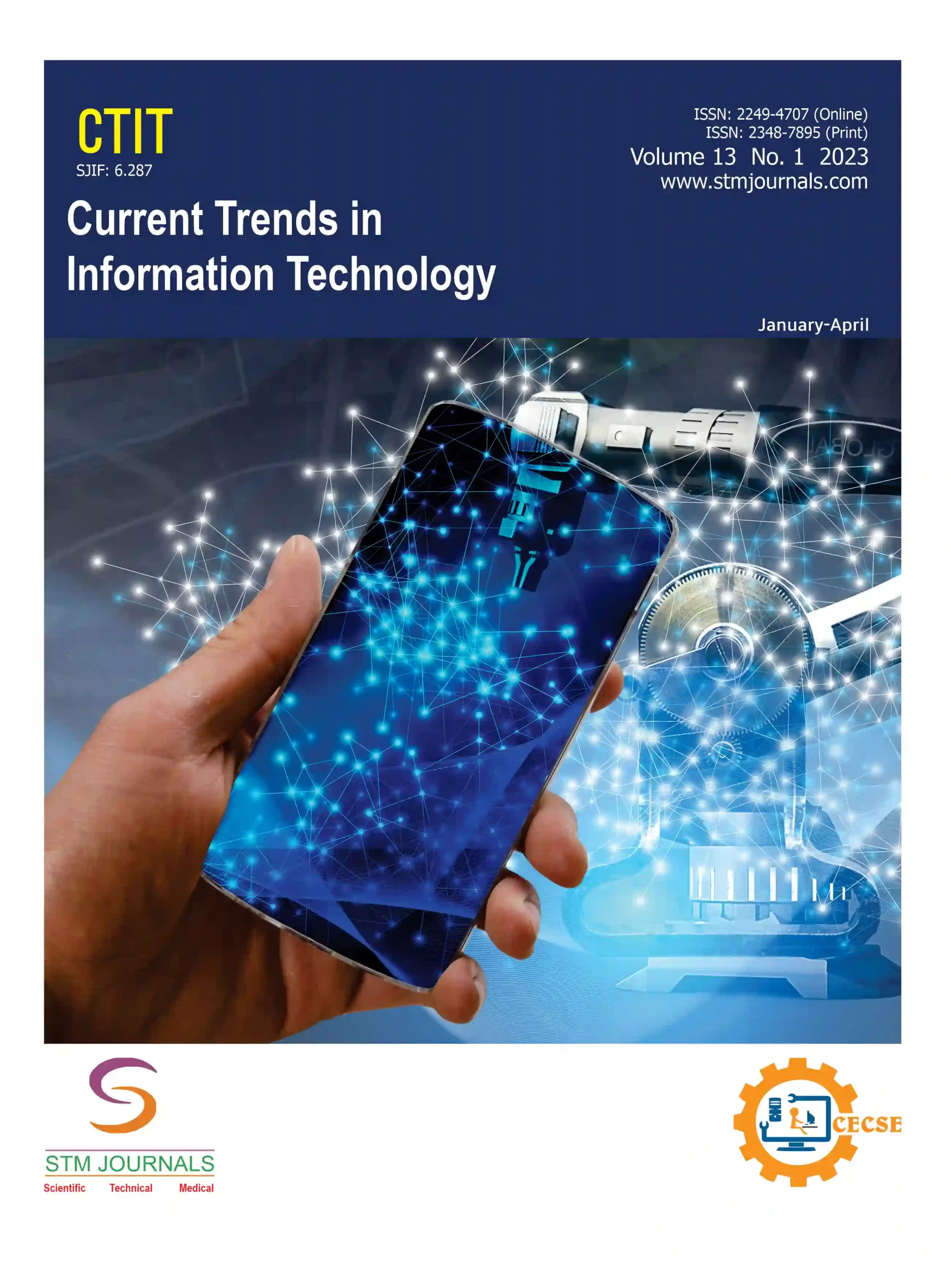
Current Trends in Information Technology (CTIT) is a peer-reviewed hybrid open-access journal launched in 2011, focused on the rapid publication of fundamental research papers on all areas of Information Technology across multidisciplinary domains.
As a cornerstone publication for the Computer/IT department, CTIT is dedicated to disseminating high-quality, impactful research that advances theoretical understanding and practical applications in the dynamic field of information technology. The journal supports the global academic and professional community by providing a trusted platform for knowledge exchange and collaborative innovation.
For current pricing details, including individual and institutional subscriptions, please visit our official subscription page: https://shop.stmjournals.com/product/current-trends-in-information-technology/
Focus & Scope: Exploring the Horizon of Information Technology Research
Current Trends in Information Technology (CTIT) provides a comprehensive platform for cutting-edge research across the vast and rapidly evolving landscape of IT. The journal emphasizes the interdisciplinary nature of modern information technology, covering fundamental theoretical advancements and their profound practical implications. Our scope is meticulously designed to capture the most significant trends and challenges facing the Computer/IT domain, ensuring that published work remains highly relevant and impactful.
At the core of CTIT’s mission is a deep dive into **Data Management**. This encompasses not just traditional data processing, storage, and security, but extends into sophisticated areas such as data governance, ethics, and lifecycle management. The journal covers advanced topics in big data management, including the intricacies of unstructured data, real-time analytics, and emerging paradigms like knowledge graphs, semantic databases, and the nascent fields of quantum and blockchain databases. A significant focus is placed on IoT data management, addressing everything from sensor data streaming and edge computing for IoT to sustainable and privacy-aware IoT solutions. Furthermore, with the proliferation of AI, CTIT explores AI/ML data management, including critical aspects like feature engineering, data labeling, explainable AI (XAI), and responsible AI data practices. Specialized applications in healthcare data management (EHRs, interoperability, AI in medical interpretation) and cybersecurity data management (SIEM, threat intelligence, data forensics) are also central to this domain, reflecting real-world challenges and innovative solutions.
The realm of **Information Databases** forms another pivotal area, ranging from fundamental database design and query optimization to the complexities of big data databases like Hadoop and Spark, and various NoSQL architectures. We encourage submissions on unstructured data management in text, document, and multimedia databases, alongside real-time data analysis techniques. Crucially, CTIT delves into knowledge graphs, Semantic Web technologies, and the transformative potential of quantum computing for databases and blockchain databases, highlighting their role in ensuring data integrity and distributed ledger technologies.
Advancements in **Network Technologies** are continuously shaping our digital world, and CTIT provides a dedicated forum for research on network architecture, protocols, security, performance, and scalability. The journal covers the latest in 5G and 6G networks, wireless and mobile communications, IoT connectivity, and the evolving landscape of cloud networking and software-defined networking (SDN). Beyond foundational concepts, we explore cutting-edge areas like network function virtualization (NFV), quantum networking, and satellite networks, emphasizing their role in creating resilient, high-performance, and globally accessible communication infrastructures, crucial for applications from smart cities to industrial automation.
**Programming Languages** remain the bedrock of all IT innovation. CTIT examines their syntax, semantics, compiler technologies, runtime environments, and modern paradigms like object-oriented, functional, and asynchronous programming. We are particularly interested in new frontiers such as domain-specific languages (DSLs), low-code/no-code platforms, and the burgeoning fields of AI-assisted programming, generative programming, and quantum programming. Research on secure software development, including memory safety and vulnerability management, is highly valued, ensuring the development of robust and secure IT systems.
The concept of **Intelligent Organization** addresses how AI, machine learning, and cognitive computing are transforming businesses and societies. CTIT features research on intelligent systems, knowledge management, automation, and data-driven decision-making, which are key drivers of digital transformation initiatives. We also highlight the critical role of human-computer interaction (HCI), the ethics of AI, explainable AI (XAI), and responsible AI practices in organizational settings. The journal explores diverse domain applications, including AI in healthcare diagnostics, fraud detection in finance, predictive maintenance in supply chains, and smart city management, demonstrating the pervasive impact of intelligent systems.
Finally, **Emerging Multidisciplinary Trends** capture the dynamic convergence of IT with other scientific fields. CTIT covers vital areas like Sustainability and Green IT, focusing on energy-efficient data centers and eco-friendly cloud solutions. It explores the profound impact of IT on biotechnology (bioinformatics, AI in genetic engineering) and neurotechnology (brain-computer interfaces). Urban technologies, Agricultural technology, and advanced communication paradigms like Terahertz and quantum secure communications are also within scope. A strong emphasis is placed on the ethical and social aspects of technology, including fairness, bias in AI, digital trust, and privacy-preserving technologies, reflecting the journal’s commitment to responsible innovation. Topics like Augmented Reality (AR), Virtual Reality (VR), and the evolving metaverse ecosystems also represent key areas of future research.
By covering these multifaceted areas, Current Trends in Information Technology serves as an essential resource for researchers, practitioners, and policymakers seeking to understand and contribute to the advancements in Computer/IT and its broader societal implications. The journal draws insights from leading open-access repositories like DOAJ, PubMed Central, and arXiv, showcasing real-world case studies and theoretical breakthroughs that are shaping the digital future.
Current Research Highlights in Information Technology
AI-Driven Data Governance and Privacy
Recent studies in leading open-access repositories (e.g., arXiv:2307.00001) are exploring how artificial intelligence and machine learning are revolutionizing data governance. Researchers are developing AI models to automate compliance with complex regulations like GDPR and HIPAA, and enhance privacy-preserving techniques such as federated learning and differential privacy. This area addresses critical challenges in balancing data utility with stringent privacy requirements, particularly in large, sensitive datasets prevalent in healthcare and finance.
Edge Computing for IoT and 5G Networks
The convergence of edge computing with 5G and the Internet of Things (IoT) is a pivotal trend. Research highlights (e.g., IEEE Communications Magazine articles) demonstrate how processing data closer to its source at the network edge significantly reduces latency, enables real-time analytics, and enhances data security. This is transforming applications in smart cities, industrial automation, and autonomous vehicles, where immediate data processing is crucial for operational efficiency and safety, addressing the exponential growth of IoT devices.
Blockchain and Distributed Ledger Technologies in Secure Information Systems
Beyond cryptocurrencies, the application of Blockchain and Distributed Ledger Technologies (DLT) is gaining significant traction in creating immutable and secure information systems. Current research (e.g., studies in ACM Digital Library) focuses on DLT’s role in ensuring supply chain transparency, maintaining integrity of electronic health records, and enabling secure identity management. These innovations tackle fundamental trust and security challenges, offering robust solutions for data provenance and verifiable transactions in complex, multi-party environments.
Contribute to the Advancement of Computer/IT Research
Your research can shape the future of information technology. Join the ranks of leading scholars publishing in Current Trends in Information Technology (CTIT).
Frequently Asked Questions
What is the scope of “Current Trends in Information Technology (CTIT)”?
Current Trends in Information Technology (CTIT) is a peer-reviewed hybrid open-access journal established in 2011. It publishes fundamental research across a wide array of Information Technology domains, including advanced data management, information databases, network technologies, programming languages, intelligent organization, and emerging multidisciplinary trends like Green IT, biotechnology-IT convergence, and quantum information processing. The journal’s scope is designed to cover the rapidly evolving landscape of IT and its interdisciplinary applications.
How does CTIT contribute to the advancement of Computer/IT research?
CTIT contributes significantly by providing a platform for rapid dissemination of cutting-edge research. It fosters innovation by publishing studies on critical areas such as AI/ML applications in healthcare data, secure cloud networking, quantum computing for data systems, and ethical considerations in AI. By featuring diverse research from academic institutions and industry, CTIT helps shape the future discourse and practical applications within the Computer/IT department and related fields.
Is CTIT a peer-reviewed journal, and what is its publication model?
Yes, Current Trends in Information Technology (CTIT) is a rigorous peer-reviewed journal, ensuring the high quality and scientific validity of published research. It operates on a hybrid open-access model, which allows authors to choose between traditional subscription-based publishing and making their articles freely available to a global audience, thereby maximizing reach and impact.
Where can I find subscription information or contribute to CTIT?
For detailed subscription information, including pricing for individual and institutional access, please visit the official STM Journals shop page at https://shop.stmjournals.com/product/current-trends-in-information-technology/. If you are a researcher looking to contribute to the advancement of Computer/IT research, you are encouraged to submit your original manuscripts to CTIT through our submission portal, details of which can be found on the journal’s official website linked from the subscription page.
What are some key emerging trends covered by CTIT?
CTIT actively covers a range of emerging trends vital to the future of Information Technology. These include, but are not limited to, the ethical and societal implications of AI, the convergence of IT with biotechnology and neurotechnology, sustainable and Green IT solutions for energy-efficient computing, advancements in quantum information processing for various IT applications, and the development of immersive technologies like the metaverse and virtual reality ecosystems. The journal consistently adapts its scope to reflect the most current and impactful research directions.