Call for Paper of Current Trends in Information Technology
Exploring the forefront of Data Management, Network Technologies, AI, and Multidisciplinary IT Innovations
Welcome to Current Trends in Information Technology (CTIT), a prestigious peer-reviewed hybrid open-access journal launched in 2011. CTIT is dedicated to the rapid publication of groundbreaking research papers across all areas of Information Technology. We pride ourselves on being a dynamic platform for researchers, academics, and industry professionals to disseminate their latest findings and contribute to the global discourse on the evolving landscape of IT.
Our journal encompasses a broad spectrum of multidisciplinary domains, ensuring that the most innovative advancements and critical challenges in information science are thoroughly explored. From the intricacies of Data Management and robust Information Databases to the revolutionary shifts in Network Technologies, advanced Programming Languages, and the transformative power of Intelligent Organization, CTIT is at the heart of technological progression. We also actively seek research on Emerging Multidisciplinary Trends that push the boundaries of what’s possible in the digital age.
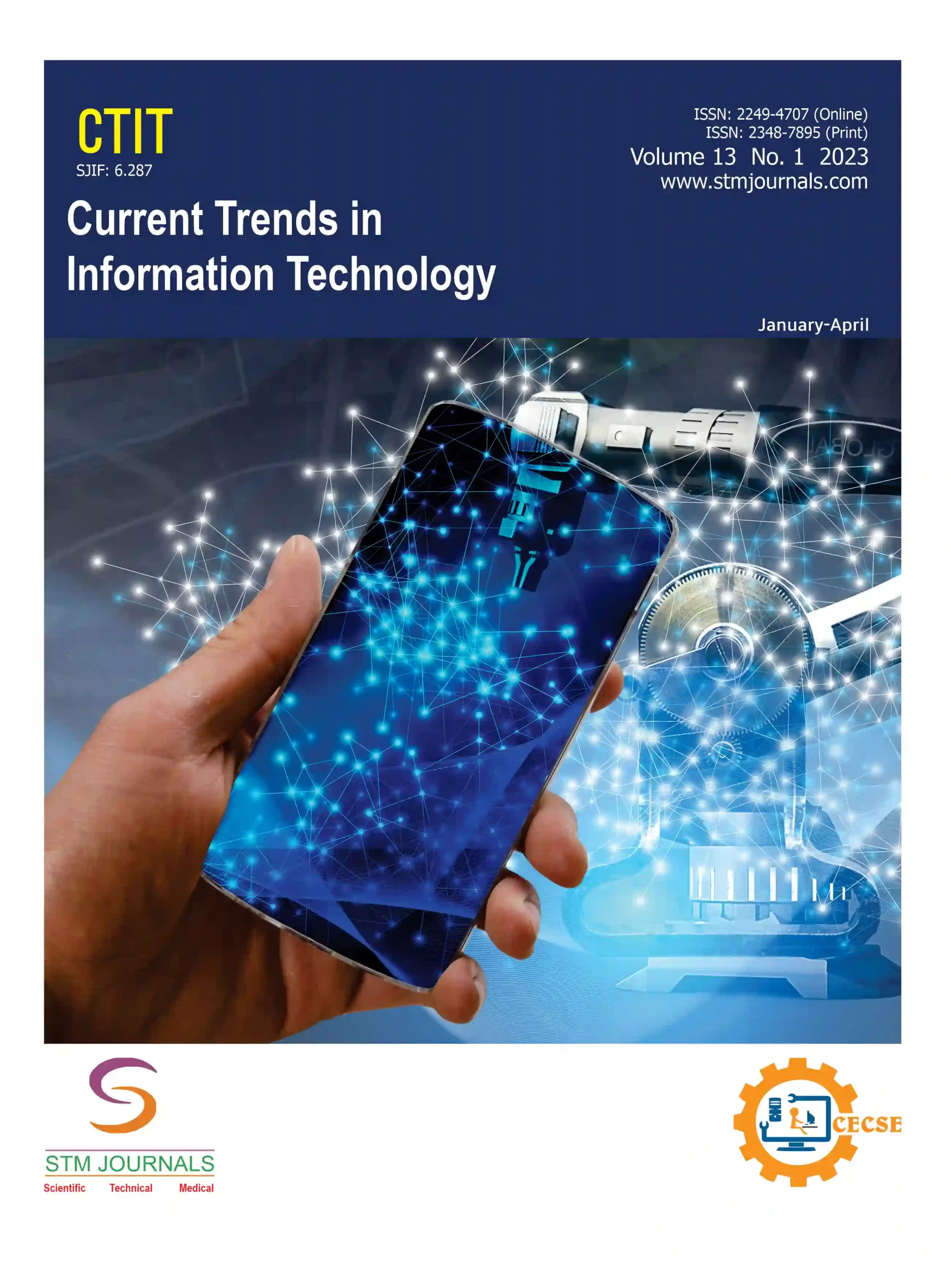
About Current Trends in Information Technology (CTIT)
Current Trends in Information Technology (CTIT) is more than just a journal; it’s a vibrant hub for the global IT research community. Since its inception in 2011, CTIT has been committed to accelerating the dissemination of high-quality, peer-reviewed research that defines the future of information science and technology. As a hybrid open-access publication, we ensure broad accessibility for your work while maintaining rigorous academic standards.
Our focus extends to the critical areas shaping modern IT, including advanced Data Management strategies, the design and optimization of Information Databases, innovations in Network Technologies, the evolution of Programming Languages, the application of Intelligent Organization principles, and the exploration of diverse Emerging Multidisciplinary Trends. We seek contributions that delve into topics such as Artificial Intelligence (AI), Machine Learning (ML), Big Data analytics, Cloud Computing architectures, the Internet of Things (IoT), Blockchain technologies, and advanced Cybersecurity measures. By publishing with CTIT, you join a legacy of influential research that is both timely and impactful.
Why Your Research Belongs in CTIT: Our Core Focus Areas
Are you looking for the ideal platform to publish your pioneering work in information technology? Current Trends in Information Technology (CTIT) offers unparalleled visibility and impact for cutting-edge research across a wide array of critical domains. We invite authors to submit papers that contribute significantly to the advancement of IT, ensuring your findings reach a global audience of academics, practitioners, and innovators.
1. Data Management: Architecting the Information Age
What are the latest advancements in handling vast and complex datasets? CTIT is keenly interested in papers addressing every facet of Data Management. This encompasses innovative approaches to data processing, efficient data storage solutions, advanced data acquisition techniques, and robust frameworks for data governance. We welcome research on ensuring data security, maintaining data privacy, and upholding data ethics in an increasingly interconnected world. Explore topics like data lifecycle management, enhancing data quality, seamless data integration, and strategic data migration.
Our scope extends to specialized areas such as master data management and effective metadata management, crucial for holistic information access and retrieval. Are you researching distributed systems? We cover Edge computing, Fog computing, and scalable big data management for both structured and unstructured data management. Real-time data analysis, knowledge graphs, and semantic databases are also key interests. Furthermore, we are at the forefront of exploring the potential of quantum computing for data systems, blockchain databases, distributed databases, and decentralized data architectures.
How does the Internet of Things impact data? CTIT welcomes studies on IoT data management, including sensor data, device data, and efficient data streaming. From data pre-processing to advanced data analytics, and the role of edge computing for IoT and cloud-based IoT data management, we cover it all. Contributions on sustainability-aware IoT solutions are particularly valuable. In the realm of AI/ML, we seek papers on feature engineering, optimizing model training data, effective data labeling and data annotation, and the critical aspects of explainable AI (XAI) and responsible AI data practices, including privacy-preserving data analysis.
We also have a strong interest in domain-specific data challenges. For Healthcare data management, this includes Electronic Health Records (EHRs), medical imaging data, paramount issues of patient privacy, data security in healthcare, interoperability of healthcare data, and AI applications in medical data interpretation. In Cybersecurity data management, research on security logs, threat intelligence, incident response, data forensics, anomaly detection, Security Information and Event Management (SIEM), and secure cloud data storage is highly relevant.
2. Information Databases: Foundations of Digital Knowledge
What defines the next generation of information storage and retrieval? CTIT is a premier venue for research on Information Databases. This includes foundational topics like database design, advancements in database systems, the efficacy of information systems, and optimization strategies for information retrieval and query optimization. We encourage submissions on advanced data modeling and efficient schema design for both relational databases and the diverse landscape of non-relational databases.
For the era of Big Data, we cover specialized databases like Hadoop, Spark, NoSQL databases, data lakes, data warehouses, data marts, and distributed file systems for big data analytics. Our scope also embraces unstructured data management, with interest in text databases, document databases, multimedia databases, XML databases, JSON databases, and semantic information extraction. How can data be processed instantaneously? We feature research on real-time data analysis, including stream processing, complex event processing (CEP), real-time data visualization, in-memory databases, and time-series databases.
Explore the power of connected information with papers on knowledge graphs and semantic databases, covering ontology design, Semantic Web principles, knowledge representation, reasoning over knowledge graphs, and SPARQL query language. As emerging fields take shape, CTIT embraces innovative concepts like quantum computing for databases, including quantum query algorithms and quantum-enhanced database operations, and blockchain databases, focusing on Distributed Ledger Technology (DLT), immutable databases, smart contracts, and secure multi-party computation.
3. Network Technologies: Connecting the Digital World
How are networks evolving to support our increasingly connected lives? CTIT provides a vital platform for research in Network Technologies. We invite submissions on cutting-edge network architecture, complex internetworking solutions, novel protocols, efficient routing and switching mechanisms, paramount issues of security, and methods for optimizing performance. Your research on scalability, reliability, availability, and resiliency of networks is highly relevant.
We delve into advanced network management, cloud networking, Software-Defined Networking (SDN), and various forms of network virtualization. Our journal is at the forefront of next-generation mobile connectivity, covering 5G and 6G networks, advanced wireless networks, and robust mobile networks. We also emphasize Internet of Things (IoT) connectivity, fog networking, edge computing in networks, and Network Function Virtualization (NFV). Future-forward topics like quantum networking, satellite networks, and LPWAN for IoT are also within our scope. Additionally, we welcome papers on advanced topics such as IP networks, overlay/underlay networks, Content Delivery Networks (CDNs), cloud-based networks, and Software-Defined Wide-Area Networks (SD-WAN).
4. Programming Languages: The Building Blocks of Innovation
What new paradigms are shaping how we build software? CTIT explores the latest in Programming Languages, from their fundamental syntax and semantics to advanced compiler and interpreter technologies. We cover runtime environments, efficient garbage collection, precise memory management, robust control flow, and the intricacies of functions and recursion. Whether your expertise lies in object-oriented programming (OOP), functional programming, imperative, or logic programming, or the complexities of concurrency and asynchronous programming, your insights are valued here.
We are particularly interested in modern innovations reshaping software development. This includes the rise of Domain-Specific Languages (DSLs), the transformative impact of low-code/no-code platforms, the potential of AI-assisted programming and generative programming, and the specialized challenges of blockchain programming and quantum programming. We also welcome papers on architectural shifts like serverless architecture and microservices-based development. Given the pervasive threat landscape, research on secure software development, memory safety, buffer overflow mitigation, secure coding standards, and software vulnerability management is crucial.
5. Intelligent Organization: AI’s Impact on Systems and Society
How are intelligent systems transforming organizations and decision-making? CTIT features compelling research on Intelligent Organization. This broad area encompasses the latest in Artificial Intelligence (AI), Machine Learning (ML), cognitive computing, and comprehensive intelligent systems. We delve into knowledge management, the role of automation, advanced decision support systems, and strategies for data-driven decision-making. Explore how digital transformation initiatives are being driven by AI, leading to concepts like smart cities and advanced digital twins.
A key aspect of this domain is the human element. We welcome papers on Human-Computer Interaction (HCI), the crucial ethics of AI in organizational settings, the necessity of explainable AI (XAI), and the implementation of responsible AI practices, including human-in-the-loop AI and emerging emotional intelligence systems. Furthermore, we encourage submissions on domain applications, such as EdTech and personalized learning systems, AI in healthcare (diagnostics, patient monitoring, robotic surgery), finance (fraud detection, credit scoring), supply chain (predictive maintenance, logistics optimization), and government (public safety, traffic management).
6. Emerging Multidisciplinary Trends: The Future of IT Unveiled
What are the cross-cutting innovations defining tomorrow’s information technology? CTIT is a nexus for research on Emerging Multidisciplinary Trends. We recognize that the most significant breakthroughs often occur at the intersection of various disciplines. This includes critical topics like Sustainability and Green IT, focusing on energy-efficient data centers, eco-friendly cloud solutions, and sustainable IoT deployments.
We are at the forefront of Biotechnology and IT convergence, featuring bioinformatics, computational biology, and AI in genetic engineering. Explore the cutting edge of Neurotechnology, including brain-computer interfaces and advanced cognitive computing systems. For urban planners and technologists, we seek papers on urban technologies, such as IT solutions for smart city management and AI-driven urban planning. In agriculture, we cover agricultural technology, specifically AI and IoT in precision farming and smart agriculture systems.
Beyond technical applications, CTIT addresses the profound Ethical and Social Aspects of technology, including technology ethics, fairness and bias in AI, digital trust, and privacy-preserving technologies. We also look to the future of communication with advanced communications like Terahertz communications and quantum secure communications. The Future of the Internet is a key area, encompassing satellite internet and global network coverage innovations. Finally, we invite research on immersive technologies like Augmented Reality (AR), Virtual Reality (VR), the burgeoning metaverse ecosystems, affective computing, and the transformative potential of quantum information processing for IT applications.
Why Submit Your Paper to Current Trends in Information Technology?
When you choose to publish with CTIT, you’re choosing a journal dedicated to amplifying the impact of your research. We offer a swift and thorough peer-review process by leading experts in your field, ensuring the quality and rigor of published articles. As a hybrid open-access journal, your work will be widely accessible, maximizing its readership and citation potential. Our commitment to timely publication means your latest discoveries reach the academic community without undue delay. Furthermore, CTIT is committed to high indexing standards, ensuring your paper gains visibility across major scholarly databases.
We provide a supportive publishing environment, fostering both established and emerging voices in information technology. Our emphasis on breadth and depth, encompassing topics from AI and ML to Blockchain and Cybersecurity, means your specialized research will find its rightful home. Engage with a community that values innovation, methodological soundness, and real-world applicability.
Submission Process & Guidelines
Ready to contribute to the next wave of IT innovation? The submission process for Current Trends in Information Technology is designed to be straightforward. We encourage prospective authors to review our detailed Author Guidelines (accessible via the submission portal) to ensure their manuscript adheres to our formatting and ethical standards. All submissions undergo a rigorous, double-blind peer-review process to ensure scientific integrity and high quality. We look for originality, scientific soundness, and significant contributions to the field of information technology. Prepare your manuscript addressing one or more of our key focus areas – from Data Science and Data Analytics to Digital Transformation and the Ethics of Technology – and join our esteemed roster of published authors.
For more details on preparing your manuscript and the complete submission checklist, please visit our dedicated author section after clicking the “Submit Paper” button. We look forward to receiving your valuable contributions.
Frequently Asked Questions
▼
CTIT covers a comprehensive range of topics in Information Technology. Our primary areas of interest include Data Management (processing, storage, security, ethics, AI/ML data), Information Databases (design, big data, real-time analysis, blockchain databases), Network Technologies (5G/6G, IoT connectivity, SDN), Programming Languages (modern innovations, secure development), Intelligent Organization (AI/ML applications, HCI, digital transformation), and Emerging Multidisciplinary Trends (sustainability, biotechnology, quantum IT, AR/VR, ethics).
▼
Yes, CTIT is a rigorous peer-reviewed journal. All submitted manuscripts undergo a thorough double-blind peer-review process by experts in the relevant fields to ensure the highest standards of scientific quality, originality, and validity before publication.
▼
Publishing with CTIT offers several benefits, including rapid publication, wide visibility due to its hybrid open-access model, rigorous peer review by leading specialists, and inclusion in key academic indexing databases. Your research will reach a broad international audience, enhancing its impact and citation potential, especially in dynamic fields like AI, IoT, Cybersecurity, and Quantum Computing.
▼
To submit your paper, please prepare your manuscript according to our detailed author guidelines, which cover formatting, citation style, and ethical considerations. You can find a link to the submission portal and further instructions by clicking on the “Submit Your Paper Now!” button on this page, which will direct you to the journal’s submission platform.
▼
Absolutely. CTIT has a strong focus on cutting-edge technological trends. We regularly feature research on Artificial Intelligence (AI), Machine Learning (ML), Deep Learning, Big Data, Cloud Computing, Internet of Things (IoT), Blockchain, Cybersecurity, Quantum Computing, 5G and 6G networks, Software-Defined Networking (SDN), Digital Transformation, and Human-Computer Interaction (HCI). We also cover ethical considerations and sustainability in IT.