Disclaimer
Some of the blog posts published on this website are created with the assistance of Artificial Intelligence (AI) tools. While efforts are made to review and edit the content for accuracy and appropriateness, there may still be instances where unintended, unnecessary, or unverified information or claims appear. Readers are advised to use their discretion while interpreting the content. The primary purpose of using AI-generated content is to provide our audience with the most recent, diverse, and wide-ranging information on various topics. The content is intended to inform and engage, not to mislead. All external links included in the blogs are intended to guide users to real and authentic workshops, programs, or resources. The information presented through those links is curated and verified to the best of our knowledge. This disclaimer is meant to inform visitors about the use of AI in content creation, acknowledge potential limitations in content accuracy, and encourage informed and responsible reading.

ctit
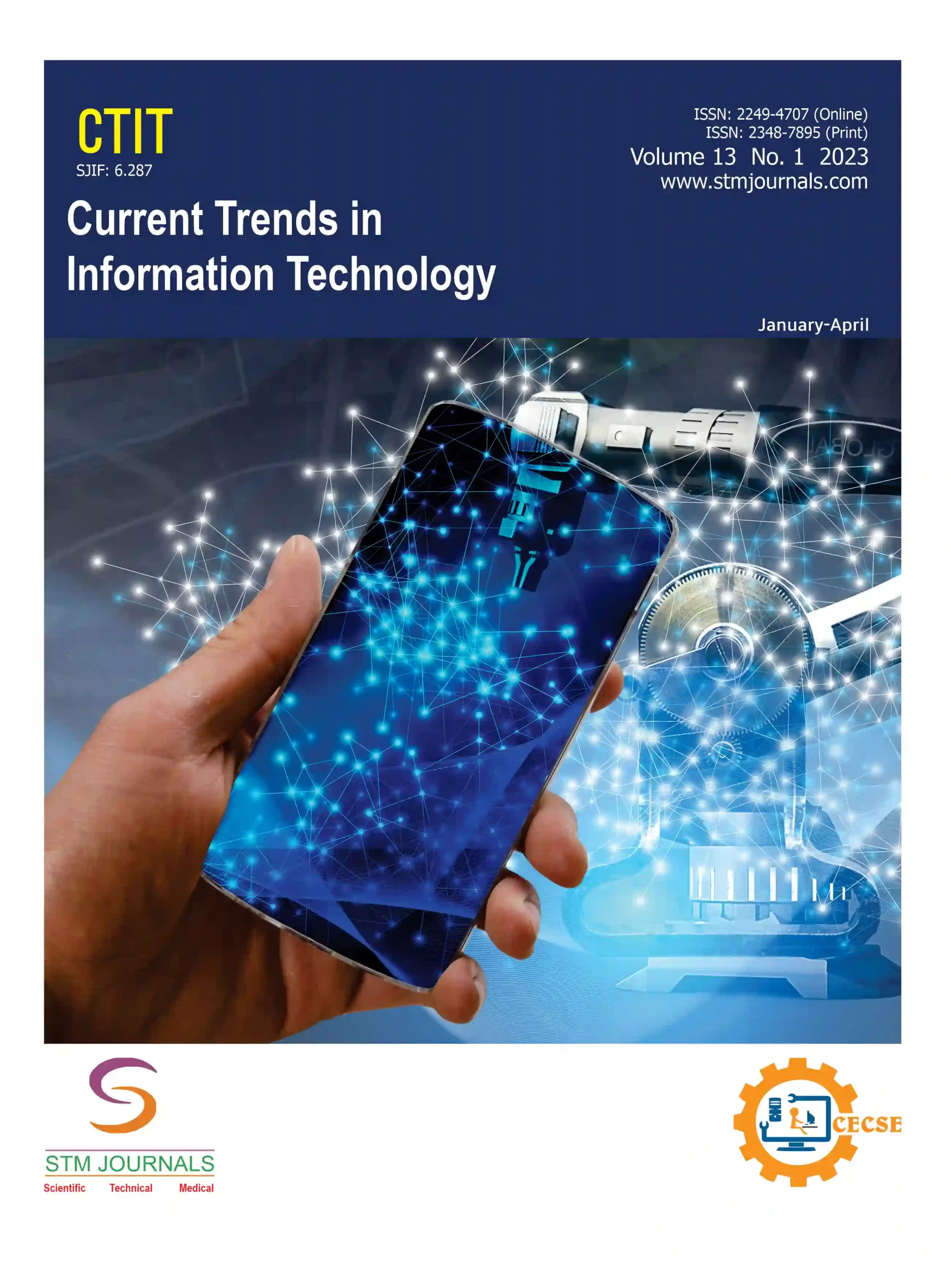
Unveiling Cutting-Edge Research: Current Trends in Information Technology for a Smarter Future
Dive deep into the evolving landscape of Information Technology with Current Trends in Information Technology (CTIT). This journal rapidly disseminates fundamental research, covering advancements in AI and data management for a smarter future across multidisciplinary domains.
About Current Trends in Information Technology (CTIT)
Current Trends in Information Technology (CTIT) is a distinguished peer-reviewed hybrid open-access journal, proudly launched in 2011 by STM Journals. Our core mission is the swift and efficient publication of groundbreaking fundamental research papers across the expansive landscape of Information Technology. CTIT serves as a crucial platform for disseminating novel findings and fostering intellectual discourse in areas spanning advanced data management, innovative networking paradigms, and the ethical implications of emerging AI and IT systems. We are committed to contributing to the global body of knowledge within the Computer/IT department, providing a vital resource for researchers, academics, and industry professionals seeking to stay abreast of the most pertinent and impactful developments in the field.
Calculate Your Subscription Price
(Pricing data below is hypothetical and for demonstration purposes. Please refer to the subscription page for actual prices.)
(Prices are subject to change. Please visit the subscription page for final pricing.)
Focus & Scope Overview: Advancing Information Technology Research
Current Trends in Information Technology (CTIT) is at the forefront of disseminating pivotal research in the ever-evolving domain of Computer/IT. Our comprehensive scope is designed to capture the dynamic shifts and advancements shaping the future of information systems and their societal impact. We actively seek contributions that delve into both fundamental theories and practical applications, offering a holistic perspective on modern IT challenges and solutions.
In **Data Management**, CTIT explores the sophisticated mechanisms required for handling vast and complex datasets. This includes pioneering research in data processing, storage, governance, and the critical aspects of data security and privacy. Recent trends show a surge in studies focusing on edge and fog computing for distributed data processing, alongside the complexities of managing big data and unstructured information. For instance, research presented on platforms like arXiv (e.g., studies on optimized data retrieval in distributed file systems) highlights the continuous innovation in information access and retrieval. The integration of AI/ML in data management for feature engineering, responsible AI data practices, and explainable AI (XAI) is also a significant area of interest, reflecting a move towards more intelligent and ethical data handling (as seen in initiatives by organizations like the Open Data Institute).
Our coverage of **Information Databases** extends from foundational database design to cutting-edge advancements. We welcome papers on relational and non-relational databases, with particular emphasis on big data databases such as Hadoop and Spark, and the architecture of data lakes and warehouses. The field is rapidly innovating with real-time data analysis via stream processing, in-memory databases, and time-series databases, crucial for applications from financial trading to IoT analytics. Emerging areas like knowledge graphs, semantic databases (e.g., ontologies in biomedical informatics as often published on PubMed Central), and especially quantum computing for databases are transforming information retrieval and processing capabilities, offering new paradigms for data storage and query optimization.
**Network Technologies** are a cornerstone of modern IT, and CTIT provides a platform for research on next-generation networks. This encompasses architectural innovations, robust protocols, advanced routing, and security measures. The journal highlights research on 5G and nascent 6G networks, wireless communication, and the ubiquitous Internet of Things (IoT) connectivity. Software-Defined Networking (SDN) and Network Function Virtualization (NFV) are critical themes, enabling unprecedented flexibility and scalability in network management. Furthermore, the convergence of networks with edge computing (e.g., studies found on IEEE Xplore detailing latency reduction in mobile edge computing for critical applications) and the exploration of quantum networking underscore our commitment to future-proof IT infrastructure.
In **Programming Languages**, CTIT publishes research on syntax, semantics, compiler technologies, and advanced programming paradigms. We are particularly interested in modern innovations such as domain-specific languages (DSLs), low-code/no-code platforms that democratize software development, and the burgeoning fields of AI-assisted and generative programming. Secure software development practices, including memory safety and vulnerability management, are also vital, addressing the growing need for robust and secure applications in a connected world. Research in these areas, often shared on platforms like GitHub or conference proceedings, showcases the ongoing evolution of developer tools and methodologies.
**Intelligent Organization** represents the application of AI and ML to transform enterprises and societal structures. This includes cognitive computing, intelligent systems, and data-driven decision-making processes. CTIT features research on digital transformation initiatives, smart cities, and digital twins, which are revolutionizing industries from manufacturing to urban planning. Human-computer interaction (HCI) research is crucial here, particularly concerning the ethics of AI in organizational settings, explainable AI (XAI), and responsible AI practices, reflecting a global push for transparent and accountable AI systems (as discussed by organizations like the AI Now Institute). Applications span diverse domains, from personalized learning in EdTech to AI-driven diagnostics in healthcare and predictive maintenance in supply chains.
Finally, **Emerging Multidisciplinary Trends** capture the interdisciplinary nature of modern IT. This includes research on Sustainability and Green IT, emphasizing energy-efficient solutions for data centers and eco-friendly cloud deployments. The convergence of Biotechnology and IT, particularly in bioinformatics and computational biology, is rapidly advancing (e.g., research on large biological datasets found on PubMed Central). Neurotechnology, urban technologies, and agricultural technology also fall within this scope, showcasing IT’s profound impact on diverse sectors. Ethical and social aspects, such as fairness, bias in AI, digital trust, and privacy-preserving technologies, are critically important. Advancements in quantum information processing, augmented reality (AR), virtual reality (VR), and metaverse ecosystems represent the future frontiers of IT innovation, promising transformative changes across all aspects of life.
Current Research Highlights in Information Technology
The Rise of Generative AI and its Ethical Implications
Recent advancements in generative AI, exemplified by large language models (LLMs) and diffusion models, are transforming content creation, drug discovery, and software development. Research focuses on improving model robustness, reducing computational overhead, and critically, addressing ethical concerns around bias, intellectual property, and responsible deployment in sensitive domains like healthcare and finance. This area is seeing rapid publication on platforms like arXiv and is a hot topic in AI ethics conferences.
Securing the Distributed Edge: Challenges and Solutions
With the proliferation of IoT devices and the demand for real-time processing, edge computing has become paramount. However, securing these highly distributed and resource-constrained environments presents significant challenges. Current research highlights innovative approaches to authentication, data encryption at the edge, anomaly detection using lightweight AI models, and the development of secure-by-design edge architectures, crucial for critical infrastructure and smart city deployments.
Quantum Computing’s Impact on Data Science and Optimization
Quantum computing, though still in its nascent stages, promises to revolutionize data science and optimization problems intractable for classical computers. Research is actively exploring quantum algorithms for machine learning (e.g., quantum support vector machines), database querying (e.g., Grover’s algorithm for search), and complex combinatorial optimization. While practical applications are some years away, fundamental research published in leading journals like Nature and Physical Review is laying the groundwork for future breakthroughs in large-scale data analysis and scientific discovery.
Contribute to the Advancement of Computer/IT Research!
Are you engaged in groundbreaking research in Information Technology? Share your discoveries with a global audience through Current Trends in Information Technology (CTIT). We invite you to contribute to the advancement of Computer/IT research and become part of a community dedicated to innovation and knowledge dissemination.
Frequently Asked Questions about CTIT
What is Current Trends in Information Technology (CTIT) about?
Current Trends in Information Technology (CTIT) is a peer-reviewed, hybrid open-access journal launched in 2011. It is dedicated to the rapid publication of fundamental research papers across all multidisciplinary domains of Information Technology, aiming to disseminate cutting-edge knowledge and foster innovation.
What are the primary focus areas of CTIT?
CTIT covers a broad spectrum of critical areas, including Data Management (data processing, security, AI/ML data), Information Databases (database design, big data, quantum computing for databases), Network Technologies (5G/6G, IoT connectivity, SDN), Programming Languages (modern innovations, secure development), Intelligent Organization (AI, ML, digital transformation), and Emerging Multidisciplinary Trends (Sustainability, Biotech-IT convergence, Neurotechnology, Ethical AI).
How can I subscribe to Current Trends in Information Technology?
You can subscribe to CTIT by visiting our official STM Journals shop at https://shop.stmjournals.com/product/current-trends-in-information-technology/. Our flexible subscription options include various durations and formats (print, online, or both) to suit your preferences.
Does CTIT accept submissions from new researchers?
Yes, CTIT encourages submissions from researchers, academics, and practitioners worldwide. We are committed to publishing high-quality, original research that contributes significantly to the field of Information Technology. Please refer to our journal’s author guidelines on the STM Journals website for submission details.
What distinguishes CTIT from other IT journals?
CTIT distinguishes itself through its hybrid open-access model, commitment to rapid publication, and broad multidisciplinary scope. We emphasize both fundamental and applied research that reflects the current and emerging trends in Information Technology, fostering a holistic understanding of the field’s advancements and societal impact.