
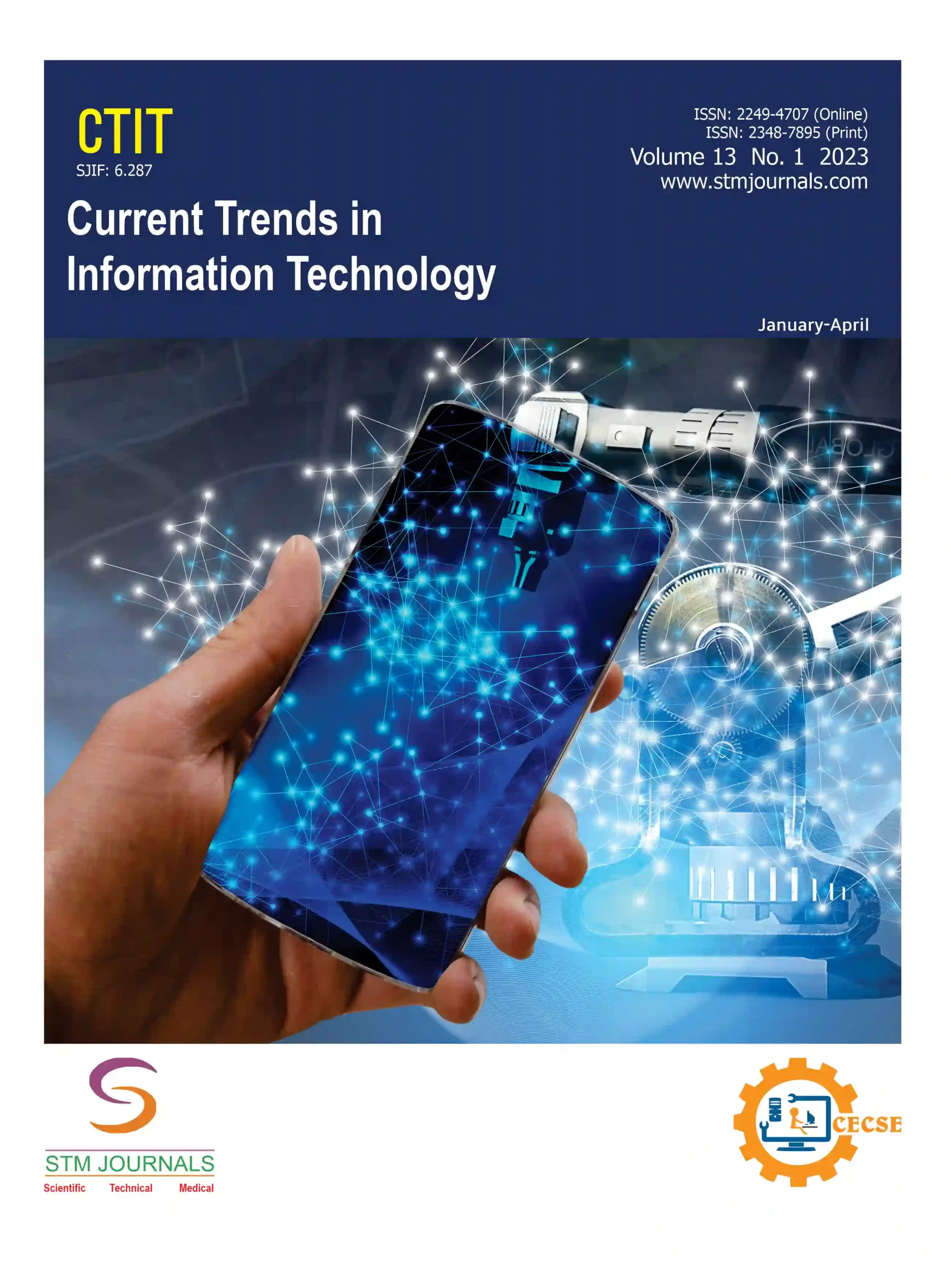
Advancing Digital Frontiers: Current Trends in Information Technology for a Smarter, Connected World
Current Trends in Information Technology (CTIT) is your definitive source for cutting-edge IT research in data management and AI applications, exploring the latest advancements in network technologies and intelligent systems development. Dive into interdisciplinary insights shaping sustainable digital transformation.
About Current Trends in Information Technology (CTIT)
Current Trends in Information Technology (CTIT), launched in 2011, stands as a distinguished peer-reviewed hybrid open-access journal dedicated to the swift dissemination of fundamental research papers across the expansive landscape of Information Technology. Our mission is to bridge academic inquiry with practical innovation, fostering a deeper understanding of the technological advancements that are reshaping our world.
As a cornerstone in the Computer/IT department’s academic publishing, CTIT prides itself on rigorous peer review, ensuring that only high-quality, impactful research reaches our global readership. We are committed to exploring the multifaceted dimensions of IT, from foundational theories to applied methodologies, and their intersections with multidisciplinary domains. The journal serves as a vital platform for researchers, academics, and industry professionals to share their insights, discoveries, and perspectives on the evolving paradigms within information technology and its profound societal implications. Our dedication to rapid publication ensures that our readers and contributors remain at the forefront of the dynamic IT field.
Focus & Scope Overview: Shaping the Future of Information Technology
The journal Current Trends in Information Technology (CTIT) is dedicated to fostering research and innovation across the most critical and dynamic sectors of Computer/IT. Our comprehensive focus spans foundational principles to groundbreaking applications, ensuring that our readership and contributors remain at the vanguard of technological progress. This section elaborates on the core areas of interest, reflecting the depth and breadth of modern Information Technology and its interdisciplinary relevance.
Data Management: The Backbone of Digital Society
In an era defined by data proliferation, robust data management is paramount. CTIT explores advanced topics in data processing, storage solutions, and governance, with a keen focus on ensuring data security, privacy, and ethical handling throughout its lifecycle. We cover innovations in information access and retrieval, crucial for navigating vast datasets. A significant emphasis is placed on emerging paradigms such as edge and fog computing, essential for distributed data processing in IoT environments. The journal also delves into big data management, including unstructured data analysis and real-time processing, critical for applications like financial trading or smart city infrastructure. Novel approaches leveraging knowledge graphs, semantic databases, quantum computing for data systems, and decentralized architectures like blockchain databases are also core to our scope, reflecting the latest advancements in resilient and efficient data ecosystems. Furthermore, we address specialized areas such as IoT data management, encompassing sensor data analytics and sustainable IoT solutions, and AI/ML data management, including feature engineering, explainable AI (XAI), and responsible AI practices. The unique challenges and innovations in healthcare data management, particularly electronic health records (EHRs) and medical imaging, alongside cybersecurity data management (e.g., SIEM systems, incident response), underscore the pervasive impact of effective data strategies across critical sectors. Research available through platforms like arXiv and PubMed Central frequently highlights breakthroughs in these data-intensive areas, demonstrating the ongoing evolution of data science.
Information Databases: Architecting Knowledge Systems
The foundation of all data-driven applications lies in sophisticated information databases. CTIT covers the intricacies of database design, query optimization, and various data modeling techniques, from traditional relational databases to contemporary non-relational (NoSQL) systems. We publish research on big data databases such as Hadoop and Spark, exploring their roles in data lakes, data warehouses, and distributed file systems for large-scale analytics. Unstructured data management, including text, document, and multimedia databases, is a key area, focusing on semantic information extraction. Real-time data analysis, stream processing, and in-memory/time-series databases are crucial for applications demanding immediate insights. The journal also features cutting-edge research on knowledge graphs and semantic web technologies, highlighting their role in advanced knowledge representation and reasoning. Future-forward topics such as quantum computing for database operations and blockchain databases, with their immutable ledgers and smart contract capabilities, are actively encouraged, reflecting the frontier of secure and resilient information systems. Open access repositories like DOAJ often feature significant contributions to these evolving database technologies.
Network Technologies: Connecting the Digital World
Connectivity is the lifeblood of modern IT. CTIT explores the latest in network architecture, internetworking protocols, routing, switching, and comprehensive network security measures. We focus on optimizing network performance, scalability, reliability, and resiliency, alongside advanced network management techniques. Key areas include cloud networking, software-defined networking (SDN), and network function virtualization (NFV), which are instrumental in building agile and programmable network infrastructures. The journal gives significant attention to next-generation wireless communication, including 5G and 6G networks, critical for the proliferation of the Internet of Things (IoT) connectivity. Topics like fog networking, edge computing integration within networks, and quantum networking represent the bleeding edge of secure and ultra-fast communication. Advanced subjects such as IP networks, overlay/underlay networks, content delivery networks (CDNs), and software-defined wide-area networks (SD-WAN) are also extensively covered, addressing the challenges of global, distributed IT environments. Insights from research initiatives published on platforms like IEEE Xplore or ACM Digital Library consistently demonstrate the rapid advancements in these networking domains.
Programming Languages: Tools for Innovation
Programming languages are the fundamental tools that bring digital concepts to life. CTIT covers the core aspects of programming, including syntax, semantics, compiler/interpreter technologies, runtime environments, and memory management. We delve into various programming paradigms such as object-oriented, functional, imperative, and logic programming, as well as concurrency and asynchronous programming vital for modern applications. The journal is particularly interested in modern innovations that streamline development and enhance capability. This includes research on domain-specific languages (DSLs), the transformative impact of low-code/no-code platforms, and the emerging field of AI-assisted and generative programming. We also cover specialized areas like blockchain and quantum programming, addressing the unique challenges and opportunities in these nascent fields. Furthermore, discussions around serverless architectures and microservices-based development, critical for scalable cloud applications, are featured. A significant component of our scope is secure software development, emphasizing memory safety, buffer overflow mitigation, and adherence to secure coding standards to combat software vulnerabilities. Research in this area, often found on open-access platforms for computer science, contributes directly to building more robust and secure digital infrastructures.
Intelligent Organization: AI-Driven Transformation
The integration of artificial intelligence (AI) and machine learning (ML) is fundamentally transforming organizational structures and decision-making processes. CTIT examines how intelligent systems, cognitive computing, and advanced knowledge management systems drive automation and enhance digital transformation initiatives across industries. We focus on the principles of data-driven decision-making and the deployment of AI in contexts such as smart cities and digital twins for predictive modeling and optimization. A crucial aspect of this domain is human-computer interaction (HCI), exploring how AI interfaces with human intelligence, and the critical ethical considerations surrounding AI in organizational settings, including explainable AI (XAI) and responsible AI practices. The journal also addresses human-in-the-loop AI systems and the emerging field of emotional intelligence systems. Practical applications across various domains are highlighted, including EdTech for personalized learning, AI in healthcare for diagnostics and robotic surgery, financial fraud detection, predictive maintenance in supply chains, and AI for public safety and traffic management in government sectors. Contributions to this field, often accessible through academic search engines and preprint servers, illuminate the practical benefits and challenges of AI adoption.
Emerging Multidisciplinary Trends: The Horizon of IT
Beyond traditional IT boundaries, CTIT embraces cutting-edge interdisciplinary research that defines the future of technology. A key area is Sustainability and Green IT, focusing on energy-efficient data centers, eco-friendly cloud solutions, and sustainable IoT deployments, addressing the environmental impact of digital infrastructure. The convergence of Biotechnology and IT is explored through bioinformatics, computational biology, and AI applications in genetic engineering. Neurotechnology, including brain-computer interfaces and advanced cognitive computing systems, represents a profound frontier. Urban technologies, leveraging IT for smart city management and AI-driven urban planning, are critical for future urban development. Similarly, agricultural technology, integrating AI and IoT for precision farming, demonstrates IT’s impact on food security. The journal also critically examines the Ethical and Social Aspects of technology, including fairness, bias in AI, digital trust, and privacy-preserving technologies, ensuring responsible innovation. Advanced communications like Terahertz and quantum secure communications, along with innovations in the future of the Internet (e.g., satellite internet), push the boundaries of global connectivity. Finally, research into augmented reality (AR), virtual reality (VR), metaverse ecosystems, affective computing, and quantum information processing for IT applications signifies our commitment to covering the most transformative and speculative areas of technological development. These trends, frequently discussed in multidisciplinary academic forums and publications, underscore the pervasive and evolving role of IT in addressing global challenges.
Current Research Highlights in Information Technology
Exploring pivotal advancements and pressing challenges driving innovation in the Computer/IT domain.
AI-Driven Cybersecurity and Data Privacy
The escalating sophistication of cyber threats necessitates advanced defensive mechanisms. Research in CTIT focuses on leveraging Artificial Intelligence and Machine Learning to develop proactive cybersecurity solutions, including anomaly detection, predictive threat intelligence, and automated incident response. A critical challenge involves balancing enhanced security with robust data privacy protocols, especially in an era of stringent regulations like GDPR. Studies often explore federated learning for privacy-preserving AI models in cybersecurity, or the application of blockchain for secure data provenance, moving beyond traditional methods.
The Evolution of Edge Computing for IoT and 5G
As the Internet of Things (IoT) expands and 5G networks become pervasive, the demand for processing data closer to its source (at the ‘edge’) is growing. Current research highlights efficient edge computing architectures that minimize latency, reduce bandwidth consumption, and enhance data processing capabilities for massive IoT deployments. This includes optimizing resource management in constrained edge environments, developing new distributed AI algorithms that can run on edge devices, and ensuring seamless integration with cloud infrastructure, addressing the challenges of scale and real-time responsiveness in diverse applications from smart manufacturing to autonomous vehicles.
Responsible AI and Ethical Considerations in System Design
The increasing integration of AI into critical societal functions demands a strong focus on responsible AI development. Research in this area explores methods for achieving explainable AI (XAI), ensuring transparency in AI decision-making, and mitigating algorithmic bias to promote fairness and equity. This also encompasses the ethical implications of AI in autonomous systems, data collection practices, and the development of frameworks for trustworthy AI. Addressing these concerns is vital for public trust and the sustainable adoption of intelligent systems across healthcare, finance, and governance, driving the need for interdisciplinary collaboration between IT, ethics, and social sciences.
Contribute to the Advancement of Computer/IT Research
Join a global community of leading scholars and innovators. Your research can shape the future of information technology.
Frequently Asked Questions about CTIT
What is the primary focus of Current Trends in Information Technology (CTIT)?
CTIT is a peer-reviewed, hybrid open-access journal dedicated to publishing fundamental research in all areas of Information Technology. Its primary focus encompasses data management, information databases, network technologies, programming languages, intelligent organization (AI/ML), and emerging multidisciplinary trends, aiming to cover the most current and impactful advancements in the Computer/IT domain.
Is CTIT an open-access journal?
Yes, CTIT operates as a hybrid open-access journal. This means it offers both traditional subscription-based access and an open-access option, allowing authors to make their published articles freely available to the global research community immediately upon publication.
What kind of research papers does CTIT typically publish?
CTIT publishes original fundamental research papers that contribute significantly to the field of Information Technology. This includes theoretical advancements, novel methodologies, empirical studies, and innovative applications across its broad focus areas, with a particular emphasis on interdisciplinary research and emerging trends that are shaping the digital landscape.
How does CTIT ensure the quality of its publications?
CTIT upholds rigorous academic standards through a comprehensive peer-review process. All submitted manuscripts undergo blind peer review by experts in the relevant fields to ensure scientific validity, originality, clarity, and relevance. This commitment to quality ensures the integrity and impact of every paper published in the journal.
How can I subscribe to Current Trends in Information Technology?
You can subscribe to Current Trends in Information Technology by visiting our official subscription page. Simply click on the “Subscribe Now” button available throughout this page or navigate directly to https://shop.stmjournals.com/product/current-trends-in-information-technology/ to access our subscription options.