
CTIT
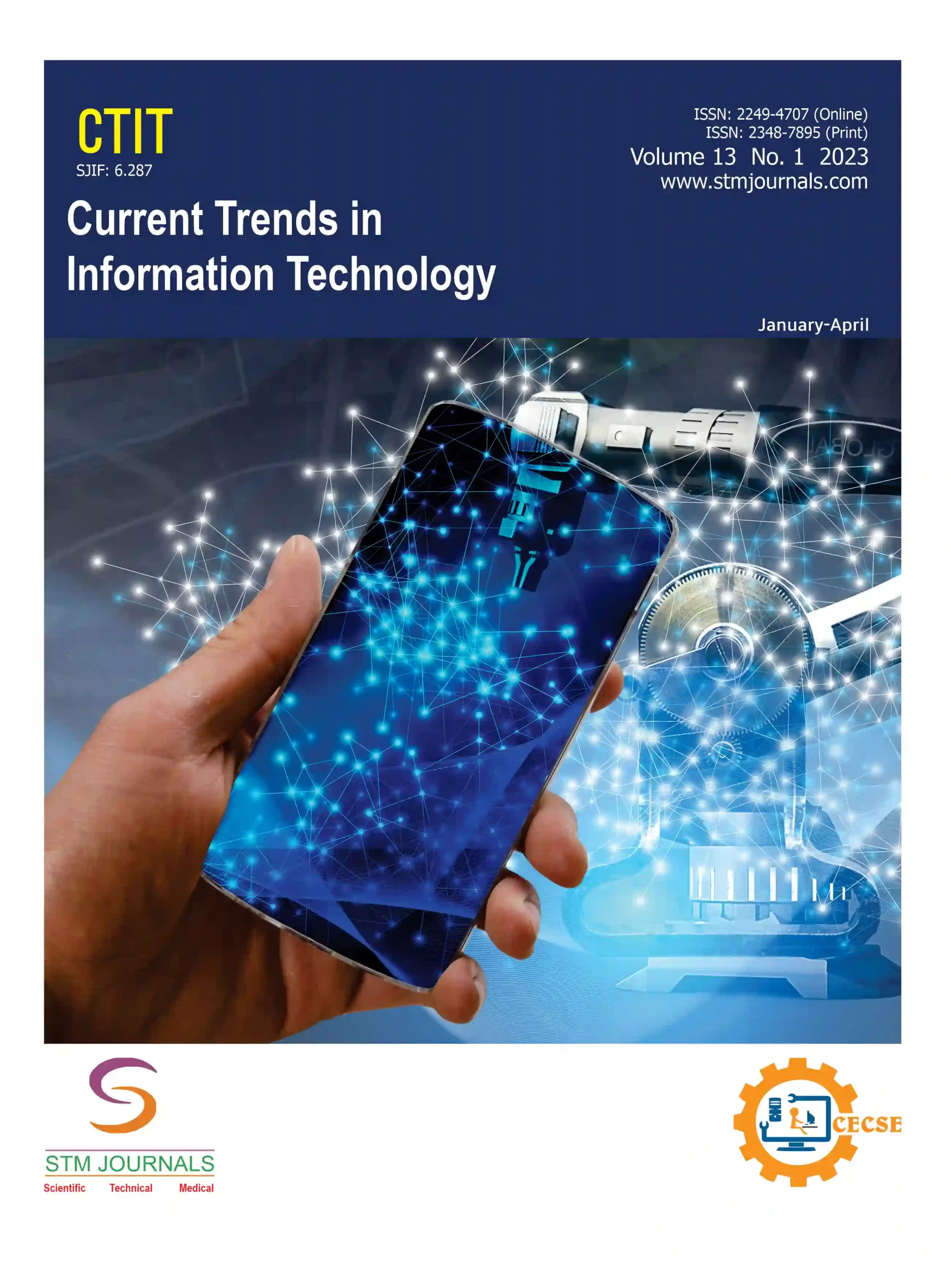
Current Trends in Information Technology (CTIT): Pioneering Research in AI, Data Science & Quantum Computing
Dive deep into the forefront of IT innovation with Current Trends in Information Technology (CTIT). This premier journal publishes rigorous, peer-reviewed research exploring cutting-edge advancements in data management, artificial intelligence, and revolutionary quantum computing applications across diverse multidisciplinary domains.
About Current Trends in Information Technology (CTIT)
Current Trends in Information Technology (CTIT) is a distinguished peer-reviewed, hybrid open-access journal, first launched in 2011. Dedicated to the swift dissemination of high-quality fundamental research, CTIT focuses on a comprehensive array of Information Technology subjects, spanning numerous multidisciplinary domains. Our mission is to serve as a vital platform for academicians, researchers, and industry professionals to publish their latest findings, fostering innovation and knowledge exchange in the rapidly evolving field of IT. By offering both open-access and subscription options, CTIT ensures broad accessibility to groundbreaking research, contributing significantly to the global scientific community. The journal rigorously upholds the highest standards of peer review, ensuring the integrity and impact of every published article. We specifically encourage submissions that push the boundaries of current understanding in areas critical to the future of computing, including advanced data management paradigms, ethical considerations in AI, and the transformative potential of quantum computing.
Since its inception, CTIT has become a beacon for influential research in the Computer/IT department, reflecting the dynamic nature of information technology. From theoretical foundations to practical applications, the journal covers diverse areas such as advanced algorithms, secure network protocols, human-computer interaction, and sustainable computing. Our commitment to timely publication ensures that readers gain access to the most recent discoveries and conceptual breakthroughs that shape the digital landscape. CTIT plays a crucial role in bridging the gap between theoretical computer science and its real-world implications, providing a critical resource for anyone seeking to understand or contribute to the next wave of technological innovation.
Calculate Your CTIT Subscription Price
Flexible Subscription Options
(USD)
*Prices are indicative and subject to change. For final pricing and special offers, please visit the official STM Journals subscription page.
Focus & Scope: Advancing the Frontier of Information Technology
The Current Trends in Information Technology (CTIT) journal is meticulously curated to encompass the most dynamic and critical areas shaping the modern IT landscape. Our extensive focus and scope ensure that researchers and practitioners find a dedicated platform for their innovative work across multidisciplinary domains. The journal prioritizes fundamental research that provides new insights, proposes novel methodologies, and addresses pressing challenges within the Computer/IT department.
Data Management: The Backbone of the Digital Economy
In an era defined by data proliferation, robust data management is paramount. CTIT covers all facets, from foundational data processing, storage, and acquisition to advanced topics like data governance, security, privacy, and ethics. We delve into the entire data lifecycle, emphasizing quality, integration, and migration strategies crucial for enterprise information systems. The journal features cutting-edge research on managing big data, unstructured data, and real-time data analysis, exploring innovations such as knowledge graphs, semantic databases, and the profound implications of quantum computing for data systems. Emerging trends like decentralized data architectures and blockchain databases are also key areas. Furthermore, CTIT highlights specialized data management challenges, including IoT data management (sensor data, streaming analytics, sustainability-aware solutions), AI/ML data management (feature engineering, data labeling, explainable AI, responsible AI), healthcare data management (EHRs, medical imaging, interoperability, AI in diagnostics), and cybersecurity data management (threat intelligence, incident response, SIEM, secure cloud storage). Research in these areas, often cited in sources like PubMed Central for healthcare or arXiv for theoretical advancements, is critical for addressing real-world complexities and ensuring data integrity and accessibility.
Information Databases: Architecting Knowledge Systems
The core of modern information systems lies in effective database design and management. CTIT publishes research on database systems, information retrieval, query optimization, data modeling, and schema design for both relational and non-relational paradigms. We are particularly interested in big data databases like Hadoop, Spark, and various NoSQL implementations, as well as data lakes and data warehouses that enable large-scale analytics. Unstructured data management, encompassing text, document, multimedia, XML, and JSON databases, alongside semantic information extraction, forms a significant part of our scope. Real-time data analysis, including stream processing, complex event processing (CEP), and in-memory/time-series databases, is crucial for timely decision-making. Pioneering research into knowledge graphs, semantic web technologies, and the application of quantum computing for enhanced database operations also falls within our purview. Blockchain databases, with their distributed ledger technology (DLT) and immutable properties, represent a transformative area for secure and transparent information management, aligning with principles discussed in papers found on platforms like DOAJ focusing on distributed systems.
Network Technologies: Connecting the Future
The evolution of network technologies underpins global connectivity and digital infrastructure. CTIT explores network architecture, internetworking, protocols, routing, switching, security, and performance optimization. We focus on scalability, reliability, availability, and resiliency, along with modern network management paradigms like cloud networking, Software-Defined Networking (SDN), and Network Function Virtualization (NFV). The journal is at the forefront of covering next-generation communication systems such as 5G and 6G networks, wireless and mobile networks, and the critical connectivity requirements for the Internet of Things (IoT). Topics like fog networking, edge computing in networks, and the burgeoning field of quantum networking are vital for future high-speed, secure, and distributed communication. Advanced discussions on IP networks, overlay/underlay networks, Content Delivery Networks (CDNs), and Software-Defined Wide-Area Networks (SD-WAN) are also central to our scope, contributing to the development of robust and efficient global networks.
Programming Languages: Tools for Innovation
Programming languages are the fundamental tools for building software systems. CTIT covers the syntax, semantics, and underlying technologies of programming languages, including compiler/interpreter design, runtime environments, memory management, and control flow. We delve into diverse programming paradigms such as object-oriented, functional, imperative, logic, concurrent, and asynchronous programming. Our scope extends to modern innovations, including domain-specific languages (DSLs), low-code/no-code platforms that democratize software development, and the exciting advancements in AI-assisted programming and generative programming. Research into blockchain programming for decentralized applications and quantum programming for novel computational problems is also highly relevant. Furthermore, we emphasize secure software development practices, including memory safety, buffer overflow mitigation, and adherence to secure coding standards, aligning with best practices promoted by organizations and research available on platforms like OWASP (Open Web Application Security Project) related publications.
Intelligent Organization: AI and Cognitive Systems in Practice
The integration of artificial intelligence (AI), machine learning (ML), and cognitive computing is transforming organizations. CTIT explores intelligent systems, knowledge management, automation, and data-driven decision-making processes that drive digital transformation initiatives. We examine the conceptualization and implementation of smart cities and digital twins, which revolutionize urban planning and industrial operations. Human-Computer Interaction (HCI) is a cross-cutting theme, addressing the ethical implications of AI in organizational settings, explainable AI (XAI), responsible AI practices, and human-in-the-loop AI systems. The journal features extensive domain applications of AI, including EdTech and personalized learning systems, healthcare (diagnostics, patient monitoring, robotic surgery), finance (fraud detection, credit scoring), supply chain (predictive maintenance, logistics optimization), and government (public safety, traffic management). This wide-ranging coverage reflects the pervasive impact of AI, as often detailed in case studies and reviews found in academic databases and open archives.
Emerging Multidisciplinary Trends: The Horizon of IT
CTIT is committed to exploring the interdisciplinary frontiers where IT converges with other fields, driving truly transformative advancements. We investigate Sustainability and Green IT, covering energy-efficient data centers, eco-friendly cloud solutions, and sustainable IoT deployments – topics gaining significant traction in research from bodies like the IEEE. The convergence of Biotechnology and IT, through bioinformatics, computational biology, and AI in genetic engineering, opens new avenues for scientific discovery. Neurotechnology, including brain-computer interfaces and cognitive computing systems, represents a profound shift in human-technology interaction. Urban technologies, agricultural technology (AI and IoT in precision farming), and advanced communications (Terahertz, quantum secure communications) highlight IT’s role in addressing global challenges. Critical ethical and social aspects, such as fairness and bias in AI, digital trust, and privacy-preserving technologies, are also central. Finally, the journal embraces the future of the internet, augmented reality (AR), virtual reality (VR), metaverse ecosystems, affective computing, and quantum information processing, recognizing their potential to redefine digital experiences and applications, with ongoing research frequently emerging on platforms like arXiv.
Current Research Highlights from CTIT’s Domain
AI for Enhanced Cybersecurity in Decentralized Systems
With the rise of blockchain and decentralized architectures, traditional cybersecurity models face unprecedented challenges. Current research in this area, relevant to CTIT’s focus, explores how advanced AI and machine learning techniques can detect anomalies, predict threats, and automate responses in distributed ledgers and peer-to-peer networks. This includes developing AI models for identifying sophisticated phishing attacks in web3 environments, leveraging federated learning for collaborative threat intelligence sharing without compromising privacy, and building intelligent agents for real-time vulnerability assessments in smart contracts. Such research is crucial for securing the next generation of financial and data exchange systems.
Quantum Computing’s Impact on Data Processing & Optimization
Quantum computing promises to revolutionize complex data processing tasks beyond the capabilities of classical computers. CTIT highlights research into quantum algorithms for database querying, such as searching unstructured data with greater efficiency, and quantum machine learning approaches for analyzing vast datasets with speed. Studies are also focusing on quantum optimization techniques for logistics, supply chain management, and financial modeling, showcasing how quantum advantage could address intractable problems. While still in nascent stages, the theoretical underpinnings and experimental results in quantum data processing are rapidly advancing, presenting both immense opportunities and significant engineering challenges.
Sustainable AI and Green IT Initiatives
The environmental footprint of Information Technology, particularly AI model training and large-scale data centers, is a growing concern. CTIT emphasizes research into “Green IT” and “Sustainable AI,” focusing on reducing energy consumption and carbon emissions. This includes developing energy-efficient algorithms and hardware, optimizing data center cooling systems, exploring renewable energy sources for IT infrastructure, and designing AI models that require less computational power without sacrificing performance. Furthermore, studies on the lifecycle assessment of IT products and the ethical implications of technological growth on resource consumption are gaining prominence, reflecting a broader societal push for responsible innovation.
Advancements in Human-Computer Interaction for XR and Metaverse
The proliferation of extended reality (XR) technologies, encompassing Augmented Reality (AR) and Virtual Reality (VR), and the conceptualization of the metaverse, necessitate profound advancements in Human-Computer Interaction (HCI). CTIT features research on intuitive interfaces for immersive environments, multimodal interaction techniques (e.g., gestures, voice, haptics), and the development of intelligent avatars. Focus is also placed on addressing cognitive load, motion sickness, and ensuring accessibility within these new digital spaces. The ethical implications of persistent virtual worlds, including data privacy, digital identity, and potential societal impacts, are also critical areas of exploration, driving the responsible development of future digital ecosystems.
Ready to Make Your Mark in Information Technology?
Contribute to the advancement of Computer/IT research. Join the esteemed community of scholars publishing with Current Trends in Information Technology (CTIT) or subscribe to stay informed on the latest breakthroughs.
Frequently Asked Questions about CTIT
What is the primary focus of Current Trends in Information Technology (CTIT)?
CTIT is a peer-reviewed, hybrid open-access journal dedicated to publishing fundamental research papers across all areas of Information Technology, with a strong emphasis on multidisciplinary domains. Its scope includes Data Management, Information Databases, Network Technologies, Programming Languages, Intelligent Organization, and Emerging Multidisciplinary Trends like AI ethics, quantum computing, and sustainable IT.
How often does CTIT publish new issues?
While specific publication frequency can vary, CTIT typically publishes a set number of issues annually, ensuring a consistent flow of new research. For the most accurate and up-to-date information on issue release dates, please refer to the journal’s official page on the STM Journals website or the subscription details provided.
Is CTIT an open-access journal?
Yes, CTIT operates on a hybrid open-access model. This means that while it offers traditional subscription options, authors also have the choice to publish their articles open access, making their research freely available to a wider global audience immediately upon publication. This model balances sustainability with broad dissemination of knowledge.
What kind of research papers does CTIT accept?
CTIT accepts original, fundamental research papers that contribute significantly to the field of Information Technology. This includes theoretical advancements, novel methodologies, empirical studies, and innovative applications across its defined focus areas such as AI, big data, cybersecurity, and emerging technologies. All submissions undergo a rigorous peer-review process to ensure scientific merit and relevance.
How can I subscribe to Current Trends in Information Technology?
You can subscribe to CTIT directly through the STM Journals online shop. Simply visit the subscription URL provided on this page, select your preferred subscription year (1 or 2 years) and journal type (Online, Print, or Both), and complete the secure checkout process. You can also use our interactive pricing calculator above to estimate your subscription cost.