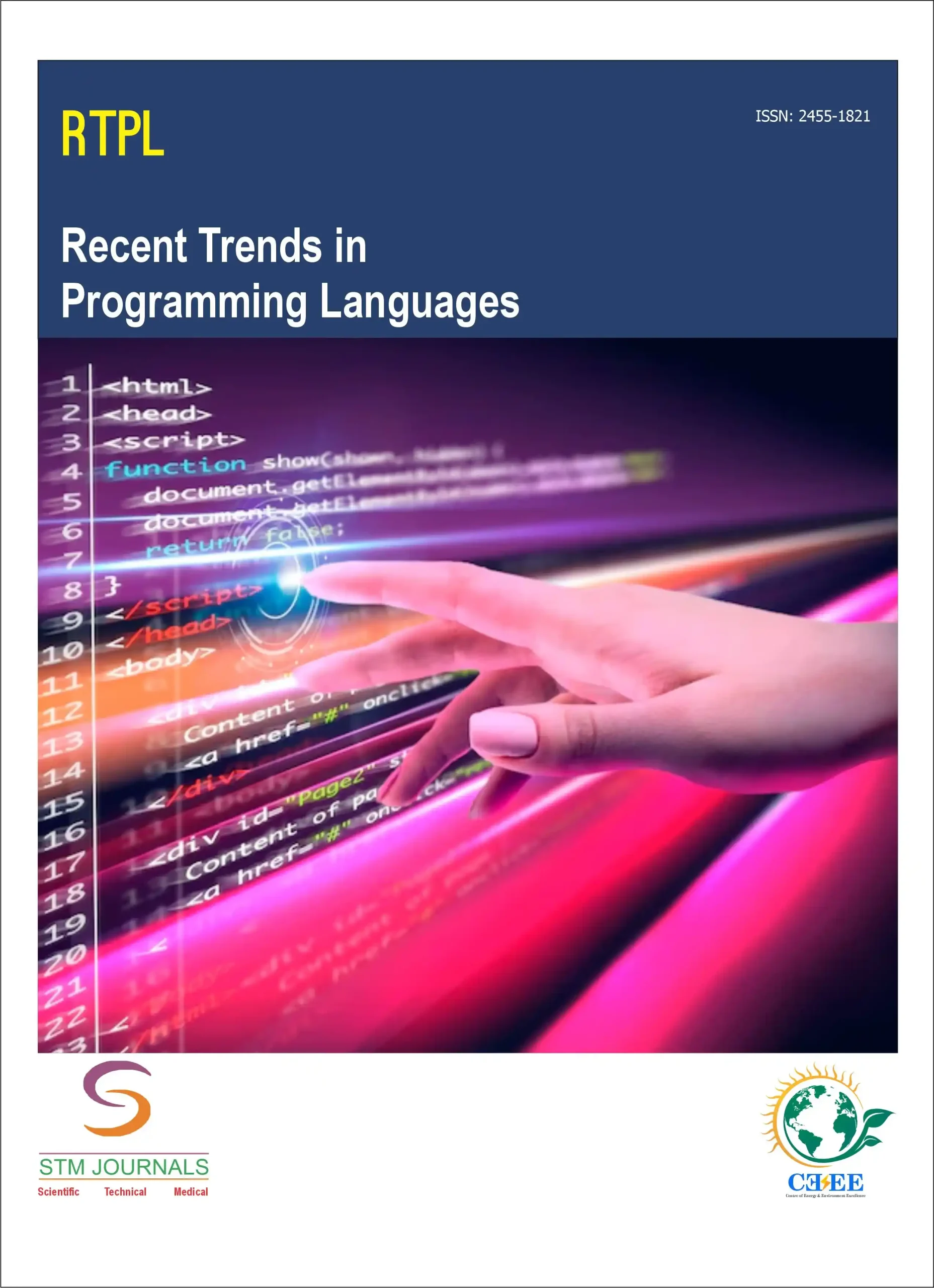
Recent Trends in Programming Languages
The Recent Trends in Programming Languages (RTPL) journal is a leading peer-reviewed publication dedicated to advancing research, innovation, and practical development in modern programming languages, language design, compiler technologies, and software engineering paradigms. This scholarly journal brings together software developers, researchers, computer scientists, educators, industry technologists, and policy-makers to exchange rigorous studies and transformative insights shaping the future of programming languages and software systems.
What This Journal Covers: Key Focus Areas
The Recent Trends in Programming Languages journal addresses a wide spectrum of foundational and emerging topics within programming language research and software engineering, including:
- Programming Language Design & Evolution: Syntax innovations, type systems, functional programming trends, object-oriented enhancements, multi-paradigm language development, dynamic vs static typing, and modern language architecture.
- Compiler Design, Optimization & Toolchains: Advanced compiler techniques, JIT compilation, code generation optimization, parsing strategies, intermediate representations, runtime systems, VM-based languages, and tooling improvements.
- Domain-Specific Languages (DSLs) & Frameworks: DSL architecture, specialized scripting languages, low-code/no-code scripting, embedded languages, and domain-focused language engineering for data science, AI, cybersecurity, and automation.
- Concurrency, Parallelism & Performance Models: Concurrent programming models, thread safety, parallel processing, distributed execution, GPU/heterogeneous computing, performance tuning, and latency-optimized language constructs.
- Security, Reliability & Memory Management: Secure programming methods, static analysis, vulnerability mitigation, automated debugging, memory-safety mechanisms, garbage collection strategies, and safe system-level programming.
Who Should Read the Journal
This journal is highly valuable for a wide range of technology professionals and researchers:
-
Software developers and architects designing modern applications, frameworks, and language-based systems.
-
Computer scientists and researchers are studying programming models, language theory, and algorithmic behavior.
-
Cybersecurity professionals focus on safe language design, vulnerability prevention, and secure coding standards.
-
Educators and academicians teaching programming language concepts, software architecture, and compiler theory.
-
Tech leaders and policy-makers are shaping digital innovation standards, quality guidelines, and software development policies.
Why It Matters
As software increasingly drives global innovation, the Recent Trends in Programming Languages play a crucial role by:
-
Publishing groundbreaking research that strengthens language design, compiler technology, and programming practices
-
Supporting innovations that enable safer, faster, scalable, and reliable software systems
-
Promoting modern paradigms for concurrency, security, and language interoperability
-
Guiding best practices in sustainable software engineering and language evolution
-
Fostering interdisciplinary collaboration across computer science, AI, cybersecurity, hardware engineering, and programming research
Through rigorous peer review, global scientific collaboration, and commitment to quality, the journal advances the evolution of programming languages, contributing to more efficient, secure, and future-ready software ecosystems worldwide.
Subscription & Access Options
Recent Trends in Programming Languages offers multiple access choices designed for institutions, researchers, and software professionals worldwide:
- Digital Access: A comprehensive online portal offering instant access to current issues, archived research, advanced search tools, and peer-reviewed programming language studies.
- Print Edition: High-quality printed volumes available for universities, research departments, technical institutions, libraries, and individual subscribers who prefer physical academic references.
Subscription plans, institutional licenses, and bulk access options are available through the STM Journals distribution system.
Why Choose STM Journals?
STM Journals ensures scholarly excellence through:
-
Rigorous peer review ensuring high scientific accuracy, credibility, and originality
-
Global research accessibility enables wthe orldwide dissemination of programming language advancements
-
Digital & print formats suited for modern developers and traditional academic environments
-
Dedicated focus on advancing programming language research, compiler engineering, and software technology
For developers, researchers, and technology innovators shaping the future of software systems, Recent Trends in Programming Languages offers a trusted, comprehensive, and influential knowledge resource.